

A traveler flying into your city no longer opens ten browser tabs to compare rental lots. They open ChatGPT and type “cheapest place to rent an SUV near the airport this weekend” — or they Google it and read the AI Overview that appears above every blue link. Whichever lot the AI names is the one that gets the call. Answer-engine optimization (AEO) — sometimes called generative engine optimization (GEO) — is the practice of structuring your car rental website, reviews, and content so ChatGPT, Perplexity, and Google’s AI Overviews cite your business as the answer instead of a competitor. It’s the single highest-leverage marketing shift for US rental operators in 2026, because the AI is now the front door and the click is disappearing behind it.
This guide is for independent and mid-size car rental operators (and the agencies running their accounts) across the USA. It explains, in plain terms, why AI search is eroding your old SEO traffic, exactly what earns an AI citation, and a seven-step playbook to make your lot the answer — wired so every AI-driven inquiry still lands in your booking pipeline.
Key Takeaways
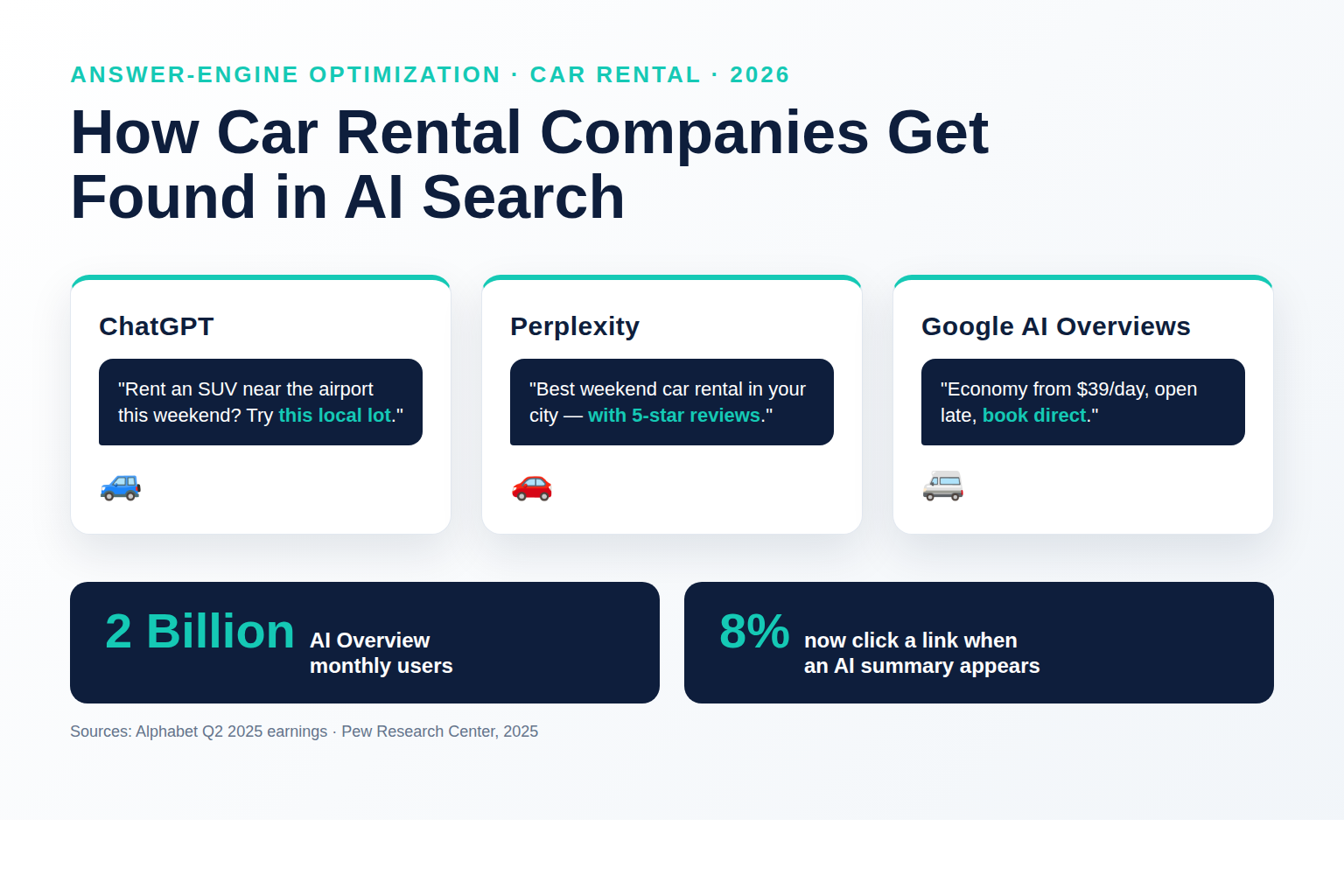
- Google’s AI Overviews now reach 2 billion monthly users and are driving 10%+ more queries for the search types that show them (Alphabet Q2 2025 earnings, via TechCrunch). Search didn’t shrink — it moved into the answer box.
- When an AI summary appears, users click a traditional result just 8% of the time, versus 15% without one — and only 1% click a link inside the summary (Pew Research Center, July 2025). If you’re not in the answer, you’re invisible.
- The #1 organic result loses about 34.5% of its clicks when an AI Overview is present (Ahrefs). Ranking first is no longer enough.
- 71% of US car rental bookings already happen online in a market worth $37.88 billion (Grand View Research). The buyers you want are digital-first — and increasingly AI-first.
- ChatGPT crossed 800 million weekly active users in late 2025 (OpenAI, via Search Engine Journal). A rental customer asking an assistant to “book me a car” is now a daily behavior, not a novelty.
Table of contents
- What AEO and GEO actually mean for a rental lot
- Why AI search is a survival issue, not a trend
- What actually earns an AI citation
- The 7-step AEO playbook for car rental companies
- Traditional SEO vs. AEO: what changes
- How to keep the booking after the AI sends it
- Frequently asked questions
What AEO and GEO actually mean for a rental lot
Answer-engine optimization (AEO) is optimizing your content so an AI answer engine — Google’s AI Overviews, ChatGPT, Perplexity, Gemini, Bing Copilot — pulls your business into its generated answer and names or links you as a source. Generative engine optimization (GEO) is the same idea, often used interchangeably, with extra emphasis on local generative answers (“SUV rental near me,” “airport car hire in Denver”). For a rental operator, the practical goal is simple: when a would-be renter asks an AI a booking-shaped question, your lot is the one it recommends.
This is different from classic SEO in one crucial way. SEO fought to rank on a page of links the user then clicked. AEO fights to be quoted inside the answer, because in AI search there often is no click — the answer is the destination. You’re no longer optimizing for a ranking position; you’re optimizing to be the sentence the AI says out loud.
Why AI search is a survival issue, not a trend
The numbers behind this shift are not subtle. Google’s AI Overviews reached 2 billion monthly users by mid-2025 and, according to CEO Sundar Pichai, are driving more than 10% additional queries for the categories where they appear (TechCrunch). Third-party trackers such as Semrush estimate AI Overviews now surface on anywhere from roughly one in seven to one in four Google searches, with informational and “near me” queries — exactly the ones renters run — among the most affected.
The click math is the part that should worry every operator. A Pew Research Center study of 900 US adults found that when an AI summary appeared, people clicked a traditional search result only 8% of the time, compared with 15% when no summary was shown — and they clicked a link inside the AI summary just 1% of the time. A quarter of the time (26%), they simply ended their session after reading the answer. Independent analysis by Ahrefs put a number on the damage: the top-ranking page sees roughly 34.5% fewer clicks when an AI Overview is present.
Share of Google searches where the user clicked a traditional result link, with vs. without an AI summary. Source: Pew Research Center, July 2025.
Here’s the counterintuitive good news: the traffic that does come through AI is unusually valuable. Adobe found that AI-referred visitors spend more time, view more pages, and add to cart at meaningfully higher rates than traditional visitors, as generative-AI referral traffic to retail and travel sites surged into the triple digits year over year (Adobe). Semrush data suggests an AI-search visitor can be worth several times a standard organic visitor (via Omnibound). Translation for a rental lot: fewer clicks, but the ones you win are high-intent people ready to book. That’s the whole ballgame in a market where 71% of US car rental bookings already happen online (Grand View Research).
What actually earns an AI citation
AI answer engines don’t invent recommendations — they assemble them from sources they can read and trust. Studying what they actually cite reveals a consistent pattern:
- You still need to rank, but ranking is no longer a guarantee. Ahrefs’ analysis found the share of AI Overview citations coming from top-10 organic pages fell from about 76% to 38%, meaning AI increasingly pulls from pages ranking well below the first page (via Search Engine Journal). The takeaway: strong rankings correlate with citations, but clear, answer-shaped content can get cited even when it isn’t #1.
- Answer-first, self-contained passages win. AI extracts sentences it can lift whole. A page that states “Sunbelt Rentals offers economy cars from $39/day at the Phoenix airport, open 6 a.m.–11 p.m.” is far more citable than a paragraph that buries the same facts in a paragraph of brand fluff.
- Structured data (schema) makes you machine-readable. LocalBusiness, Service, FAQPage, and Review schema hand the AI clean facts — name, area served, price range, hours, ratings — in a format it doesn’t have to guess at.
- Third-party mentions and reviews matter more than ever. AI Overviews and ChatGPT lean heavily on community and review sources. Fresh, plentiful Google and Facebook reviews, plus mentions on directories and local sites, are signals the AI reads as trust.
- Speed and crawlability are table stakes. If your site is slow or renders its content only after heavy JavaScript, AI crawlers may never see it. Google’s own Deloitte “Milliseconds Make Millions” study found a mere 0.1-second mobile speed improvement lifted travel-site conversions by 10.1% — and the same fast, clean HTML that converts humans is what lets AI read you.
Where those citations get sourced also tells you where to be visible. Independent tracking of AI referral traffic shows ChatGPT dominating, with Perplexity and Gemini splitting most of the rest (SE Ranking):
Approximate share of AI-assistant referral traffic to websites, 2025. Source: SE Ranking AI traffic study. Shares shift as assistants gain and lose users; treat as directional.
The 7-step AEO playbook for car rental companies
Here’s the concrete build. None of it requires you to become an SEO — it requires your website and CRM to speak the AI’s language.
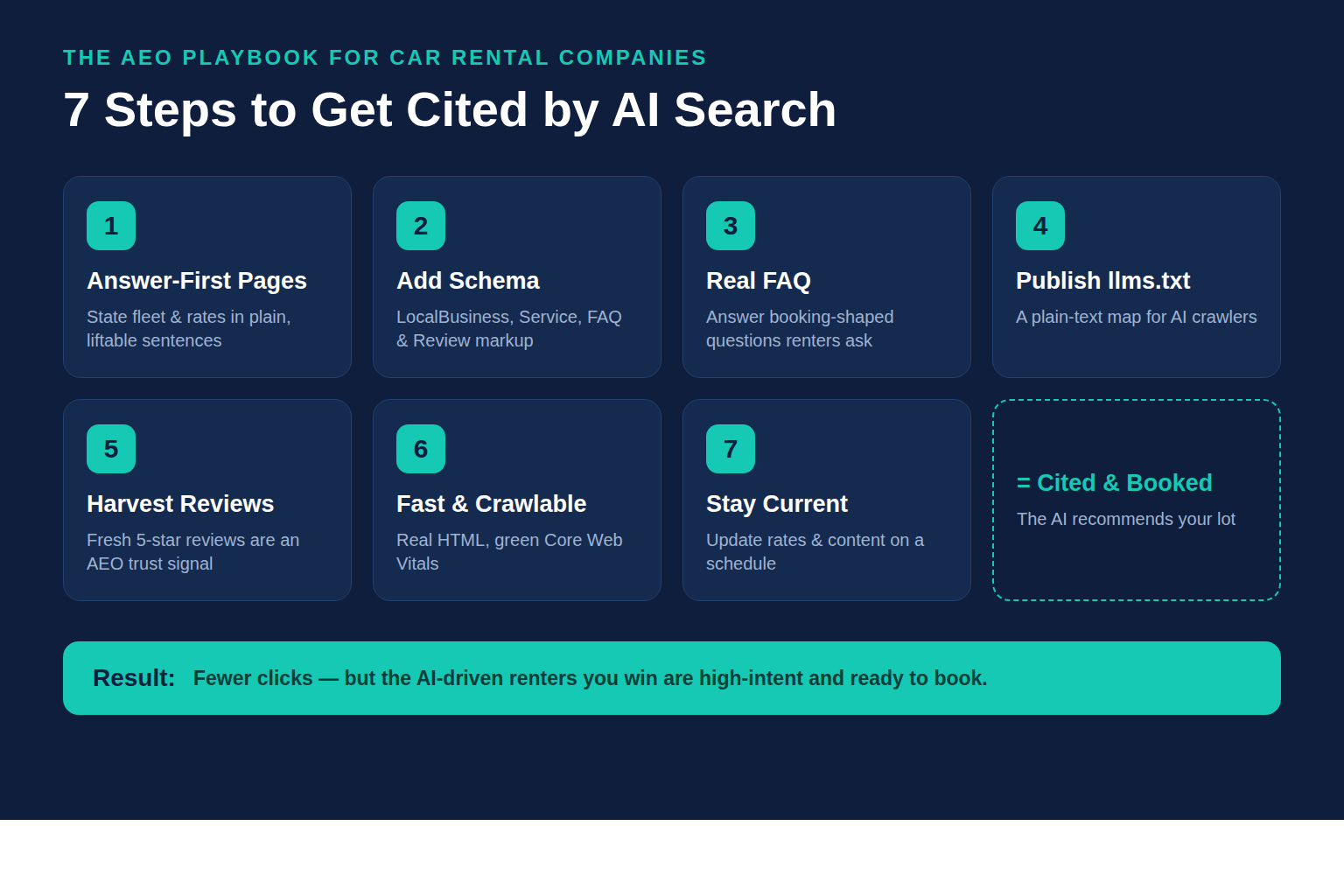
- Publish an answer-first fleet-and-rates page. For each vehicle class and location, state the facts in plain sentences an AI can lift: “Economy cars from $XX/day,” “SUVs and 8-passenger vans for airport pickup,” “open Monday–Sunday, 7 a.m.–10 p.m., serving [city] and [nearby suburbs].” Lead with the answer; save the story for below.
- Add the four schema types that make you machine-readable. LocalBusiness (name, area served, hours, phone), Service (each rental class + price range), FAQPage (real questions renters ask), and Review/AggregateRating. This is exactly the structured data our prebuilt rental websites emit automatically.
- Build a real FAQ that answers booking-shaped questions. “Do you rent to drivers under 25 in [city]?” “What deposit do you hold on an SUV?” “Can I pick up after a late flight?” Each Q&A is a self-contained passage an AI can quote — and it doubles as FAQPage schema.
- Publish an
llms.txtfile and keep your sitemap clean. Anllms.txtfile is a plain-text map that tells AI crawlers what your site is and where the important pages live — the AI-era equivalent of a sitemap. (Every site we build ships one and regenerates it on each publish.) - Turn your happy returns into a review engine. Because AI leans on review signals, a steady flow of fresh Google and Facebook 5-star reviews is now an AEO asset, not just a reputation nicety. Automating the ask is the highest-ROI move here — see our review harvesting automation.
- Make the site fast and crawlable. Ship real HTML, not a JavaScript shell an AI crawler can’t read, and keep Core Web Vitals green. This is the entire premise of our Astro-built rental sites — and we cover the mechanics in depth in Car Rental Website Speed.
- Keep it current. AI favors fresh, dated content. Update your rates, seasonal availability, and FAQ on a schedule, and publish niche blog posts (like this one) that answer the questions your renters actually ask.
Traditional SEO vs. AEO: what changes
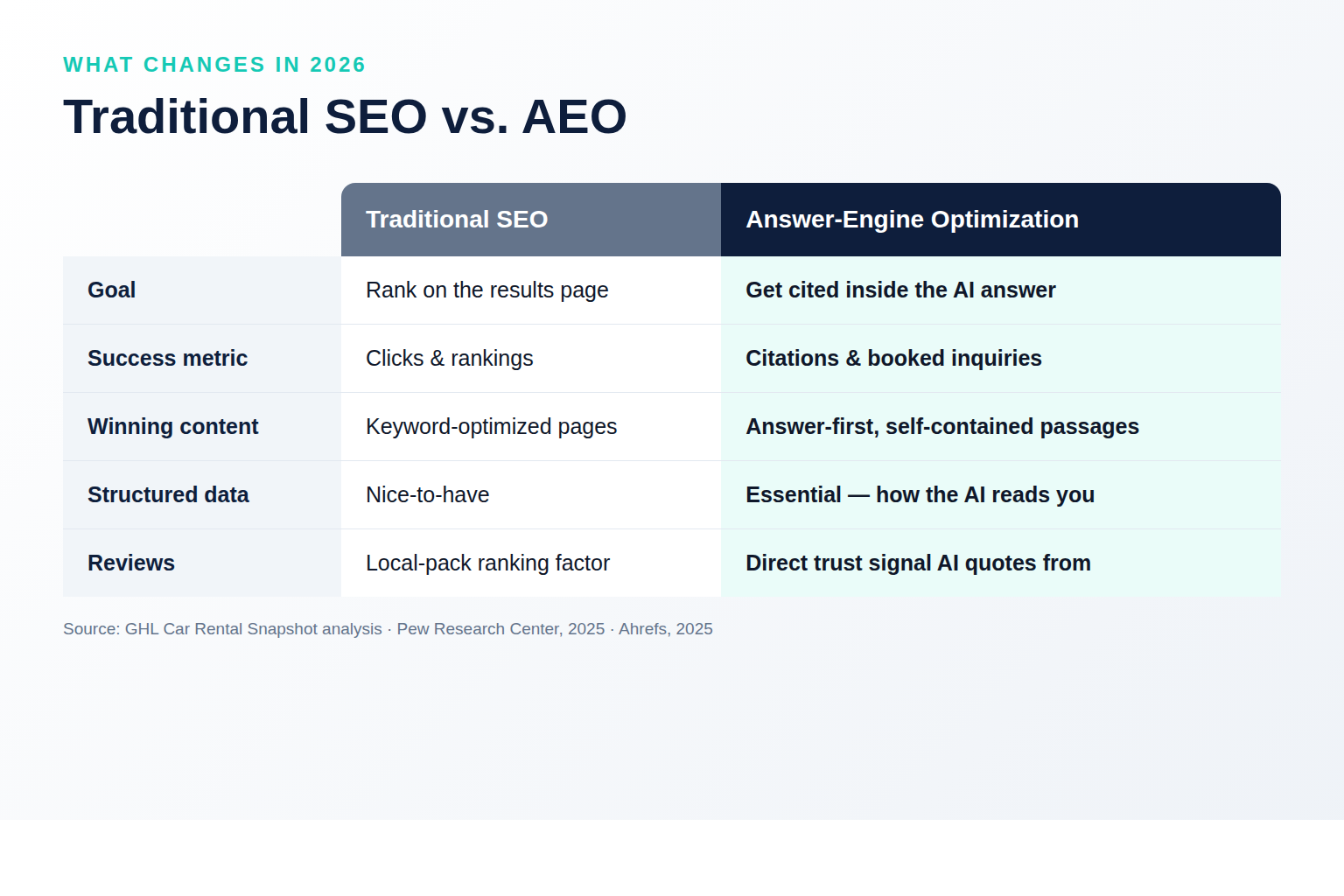
AEO doesn’t replace SEO — it sits on top of it. But the emphasis shifts in ways that matter for how you spend your limited time and budget:
| Dimension | Traditional SEO | Answer-Engine Optimization (AEO) |
|---|---|---|
| Goal | Rank on the results page | Get cited inside the AI answer |
| Success metric | Clicks and rankings | Citations, brand mentions, and booked inquiries |
| Winning content | Keyword-optimized pages | Answer-first, self-contained passages |
| Structured data | Nice-to-have | Essential — it’s how the AI reads you |
| Reviews’ role | Local-pack ranking factor | Direct trust signal AI quotes from |
| Speed | Ranking factor | Ranking factor and crawlability gate |
| Freshness | Periodic refreshes | Ongoing — AI favors current, dated info |
The good news for independent operators: AEO rewards clarity over budget. A small lot with a fast, well-structured site, a real FAQ, and a steady stream of reviews can out-cite a national chain whose bloated site buries the facts. For a deeper local-search foundation, pair this with our local SEO playbook — the two reinforce each other.
How to keep the booking after the AI sends it
Winning the citation is half the job. The renter still has to reach you — and AI-driven visitors arrive ready to act, often after hours, on their phone, in a hurry. If your response is a contact form nobody checks until Monday, the high-intent visitor the AI just handed you leaks straight to the next lot.
This is where the AEO front end has to connect to an automation back end. The same GoHighLevel snapshot that captures a missed call captures an AI-driven inquiry: instant text-back, an AI chatbot that books the reservation on the spot, reminders that stop no-shows, and a review request after return that feeds the next round of AI citations. AEO fills the top of the funnel; automation keeps the booking from leaking out the bottom.
Being cited by the AI is worthless if the booking dies in a form. The lots winning in 2026 pair a readable, fast website with a pipeline that answers in seconds — the citation and the follow-up are one system, not two projects.
If building all of that in-house sounds like a second job, that’s exactly what we do: fast, schema-rich Astro websites, done-for-you social media that seeds the third-party mentions AI reads as trust, and the GoHighLevel automation that turns an AI-driven inquiry into a booked, reviewed, repeat renter.
Frequently asked questions
What is AEO (answer-engine optimization) for a car rental business?
AEO is the practice of structuring your rental website, reviews, and content so AI answer engines — Google's AI Overviews, ChatGPT, Perplexity, Gemini — cite your business as the answer when someone asks a booking-shaped question like 'where can I rent an SUV near the airport this weekend.' Unlike classic SEO, which fights to rank on a page of links the user clicks, AEO fights to be quoted inside the AI's generated answer, because in AI search there's often no click at all. In practice it means answer-first content, structured data (schema), fresh reviews, and a fast, crawlable site.
Why does AI search matter for car rental companies specifically?
Because rental buyers are digital-first and increasingly AI-first. 71% of US car rental bookings already happen online (Grand View Research), Google's AI Overviews reach 2 billion monthly users, and ChatGPT passed 800 million weekly users in late 2025. Renters ask assistants to compare lots, rates, and airport options — and when an AI summary appears, people click a traditional link only 8% of the time versus 15% without one (Pew Research). If the AI can't read and cite your lot, it recommends a competitor it can.
How do I get my rental company cited by ChatGPT and Google's AI Overviews?
Seven moves: (1) publish answer-first fleet-and-rate pages that state facts in liftable sentences; (2) add LocalBusiness, Service, FAQPage, and Review schema; (3) build a real FAQ answering booking questions; (4) publish an llms.txt file and keep your sitemap clean; (5) automate a steady flow of Google and Facebook reviews; (6) make the site fast and crawlable with real HTML, not a JavaScript shell; and (7) keep content current, since AI favors fresh, dated info. Rankings still help, but clear, structured, answer-shaped content can get cited even when you aren't #1.
Is AEO different from local SEO?
They overlap but aren't identical. Local SEO aims to rank in Google's local pack and Maps for 'near me' searches. AEO (and its local cousin GEO) aims to be the source an AI answer engine quotes in its generated response. The foundations — accurate business info, structured data, reviews, a fast site — feed both, so you build them once and win in both places. AEO simply adds an emphasis on answer-first passages and machine-readable facts, because the AI is extracting and summarizing rather than just listing.
Do I need a new website for AEO, or can I fix my current one?
You can improve most sites, but the ceiling depends on the platform. AEO rewards fast HTML, clean schema, and an llms.txt file — things that are effortless on a modern static build and a fight on a heavy WordPress or drag-and-drop site. If your current site is slow, buries facts in JavaScript, or can't emit proper structured data, a purpose-built rental site (like our Astro Get a Website service) usually pays for itself faster than retrofitting. Either way, pair the front end with a booking pipeline so the AI-driven inquiries you win actually convert.
About the author: Priya Sandoval runs a boutique GoHighLevel agency in Austin, Texas that resells done-for-you snapshots to local service businesses, with car-rental operators as her fastest-growing segment. She is obsessed with the unglamorous plumbing — schema, tags, trigger timing, and the structured content that turns a one-time renter into a repeat booking — and writes about what actually ships and converts, not what looks good in a demo.
Related reading:
- Car Rental Website Speed in Miami: Why Fast Sites Book the Weekend (Astro vs WordPress vs Wix)
- Local SEO for Car Rental Businesses: The 2026 Google Ranking Playbook
- AI Chatbots for Car Rental Businesses: Turn 24/7 Chat Into Booked Rentals
- How to Get More Google Reviews for Your Phoenix Car Rental Business
- Car Rental Website Conversion Optimization: Turn Visitors Into Bookings
Editorial note: figures cited are drawn from the third-party research linked inline and reflect the sources as of publication. AI Overview usage and query-share figures are from Alphabet’s Q2 2025 earnings (via TechCrunch), Semrush, and BrightEdge; click-behavior figures are from the Pew Research Center’s July 2025 study; click-loss figures are from Ahrefs; AI-referral and citation-source figures are from SE Ranking, Adobe, and Ahrefs (via Search Engine Journal); market and booking-channel figures are from Grand View Research; page-speed conversion data is from Google’s Deloitte “Milliseconds Make Millions” study. AI-assistant traffic shares and query volumes shift quickly — verify current figures before making decisions. GHL Car Rental Snapshot builds GoHighLevel automation systems and rental websites — it is not a car rental company, insurer, or payment processor.