

A traveler lands at O’Hare, opens their phone, and searches “car rental Chicago.” Before they reserve anything, they do what everyone does now: they tap your Instagram, glance at your Google profile, skim your Facebook. If your last post was from two summers ago and nobody ever answered the “is the SUV free this weekend?” comment, they don’t call to check — they just book the lot whose feed looks alive and answers fast. An empty or silent social presence is the quietest way an independent Chicago car rental company leaks weekend bookings it already earned, and the fix isn’t “post more when you get a minute” — it’s a done-for-you system that keeps every channel active and every message answered while you run the counter.
This is a plain-English breakdown for Chicago rental operators (and the agencies marketing them) on exactly how a dead feed costs bookings in a phone-first, airport-driven, tourist-heavy market — the four pain points that quietly drain your lot every month, the real numbers behind each one, and what a hands-off social operation looks like when it’s done right.
Key Takeaways
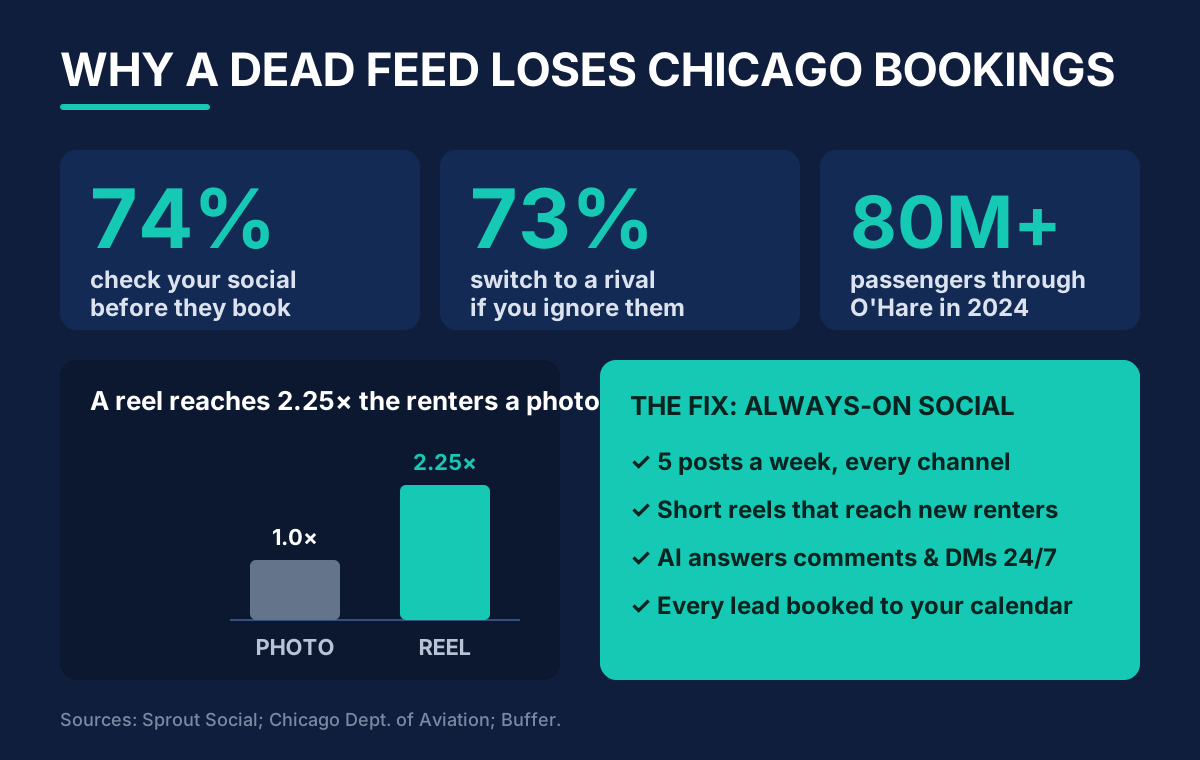
- Chicago is a phone-first rental market at record scale. O’Hare moved more than 80 million passengers in 2024 (Chicago Department of Aviation) and Choose Chicago counted 55.3 million visitors generating $20.6 billion in economic impact (Choose Chicago) — most of them deciding which lot to book on a phone, in seconds.
- Renters vet you on social before they reserve. Roughly 74% of consumers check a brand’s social profiles before visiting in person (Sprout Social), and 67% now buy through social media at least once a month (GRIN 2025 Modern Consumer Survey, via Business Wire). An empty grid reads as “closed.”
- The problem is almost never effort — it’s time. Marketers recommend 3–5 posts a week on each major platform just to stay visible (Hootsuite) — a cadence that’s nearly impossible to hit by hand while running key handoffs, deposits, and returns. So the feed goes dark.
- Silence sends the booking down the street. About 73% of consumers expect a brand to respond within 24 hours or sooner — and the same share will buy from a competitor when a brand fails to answer (Sprout Social). Every cold DM is a re-rent handed to the next lot.
- Short video is where new renters find you. Instagram Reels reach about 2.25× more accounts than single-image posts (Buffer analysis), and short-form video delivers the highest ROI of any content format for marketers (HubSpot). If you’re not posting it, you’re invisible to the audience you haven’t met yet.
Table of contents
- What an empty feed actually costs a Chicago rental lot
- The Chicago math: a phone-first, tourist-heavy rental market
- Pain #1: You run the lot, so nobody runs the feed
- Pain #2: Renters vet your feed before they book
- Pain #3: Comments and DMs go cold — and cold means lost
- Pain #4: You’re invisible where discovery now happens
- What done-for-you social actually looks like
- A realistic 90-day picture
- Frequently asked questions
What an empty feed actually costs a Chicago rental lot
It’s tempting to file social media under “nice to have” — the thing you’ll get to after the returns are cleaned and the deposits are settled. But for a car rental company, social isn’t a billboard. It’s the storefront window every renter walks past before they decide to walk in.
Think about the actual sequence. A renter needs a car for a Chicago weekend. They search, they land on three or four lots, and then — before they hand over a card or a deposit — they do a trust check. They look at your photos, your recent posts, your reviews, and whether you seem to answer people. That check takes fifteen seconds and it’s ruthless. A lot with a fresh reel of this week’s fleet, a pinned “airport pickup in 3 steps” carousel, and replies under every comment reads as open, staffed, and safe. A lot whose last post is a faded graphic from a summer ago reads as gone.
Nobody tells you they scrolled past. There’s no missed-call log for “saw your dead Instagram and booked someone else.” That’s what makes an empty feed the most expensive leak on the lot: it’s invisible, it compounds, and it costs you the exact high-intent renter your ads and your Google ranking worked to produce. You pay full price for the click and then lose it at the trust check.
The Chicago math: a phone-first, tourist-heavy rental market
Chicago is close to a best-case market for rental demand — and a worst-case market for looking absent. The audience is enormous, overwhelmingly mobile, and almost always deciding fast between multiple lots.
Start with the raw traffic. O’Hare International handled more than 80 million passengers in 2024, ranking among the ten busiest airports in the world (Chicago Department of Aviation). Add Midway on top of that. Then layer in tourism: Choose Chicago reported 55.3 million visitors in 2024, up 6.5% year over year, generating $20.6 billion in economic impact (Choose Chicago). That’s the pool of travelers, business visitors, and locals your lot competes for every weekend — inside a U.S. car rental industry estimated at roughly $65.3 billion in 2025 (MMCG Investment Research).
Here’s the part operators underestimate: that demand doesn’t decide at your counter anymore. It decides on a phone, on the way from baggage claim, comparing lots that all look roughly similar on price. In that moment, your social presence is the tiebreaker. Globally, people now spend about 2 hours and 21 minutes a day on social media (DataReportal, Digital 2025) — which means the renter comparing you to the lot down the road is doing it inside the apps where you’re either present or absent.
The rental owners who think they “don’t have time for social” are usually the ones bleeding the most from it. Their ads and their Google ranking are doing the hard part — producing a ready-to-book renter — and then a two-year-old feed quietly talks that renter out of it. You’re not choosing whether to be on social. Your renters already put you there. You’re only choosing whether you look open.
Pain #1: You run the lot, so nobody runs the feed
Let’s name the real problem, because it isn’t laziness and it isn’t “not understanding social.” It’s arithmetic. Between key handoffs, walk-ins, deposit holds, cleaning returns, and chasing the one car that came back late, “post something today” never wins the day.
And “keeping up” is a real bar, not a token effort. Social marketers put the baseline to stay visible at roughly 3–5 posts a week on each major platform (Hootsuite) — and that’s per channel, before you account for answering comments and DMs. For a rental operator who gets maybe an hour of desk time between walk-ins, that cadence is simply out of reach by hand. It’s not a discipline problem; it’s a math problem.
So the feed goes quiet. Then it goes stale. Then it becomes a liability, because a stale feed is worse than no feed: it actively signals “this place might be closed.” And doing it properly by hand is genuinely a second job — Facebook, Instagram, Google Business Profile, TikTok, YouTube, and the rest each want different image sizes, captions, and posting rhythms. Nobody running a lot has the hours to feed all of them well.
Pain #2: Renters vet your feed before they book
Modern renters do their own background check, and social is where they run it. Roughly 74% of consumers check a brand’s social profiles before visiting in person (Sprout Social), and social has quietly become a genuine buying surface: 67% of U.S. consumers now make a purchase through social media at least once a month (GRIN 2025 Modern Consumer Survey, via Business Wire). And discovery increasingly starts on social — it’s now one of the fastest-growing ways consumers find new brands (DataReportal, Digital 2025).
For a rental lot, that vetting is brutally concrete. The renter is asking, in about fifteen seconds:
- Are these people actually operating? Recent posts say yes. Silence says maybe not.
- What does the fleet really look like? Real photos of your actual cars beat a stock hero shot every time.
- Do they treat renters well? Replies, reviews, and answered questions are the proof.
- Do I trust them with my deposit? A professional, active presence is what makes a stranger comfortable putting a card on file.
Fail that check and you don’t get a rejection — you get nothing. This is exactly the moment a comic-strip version of the decision plays out on the renter’s phone:
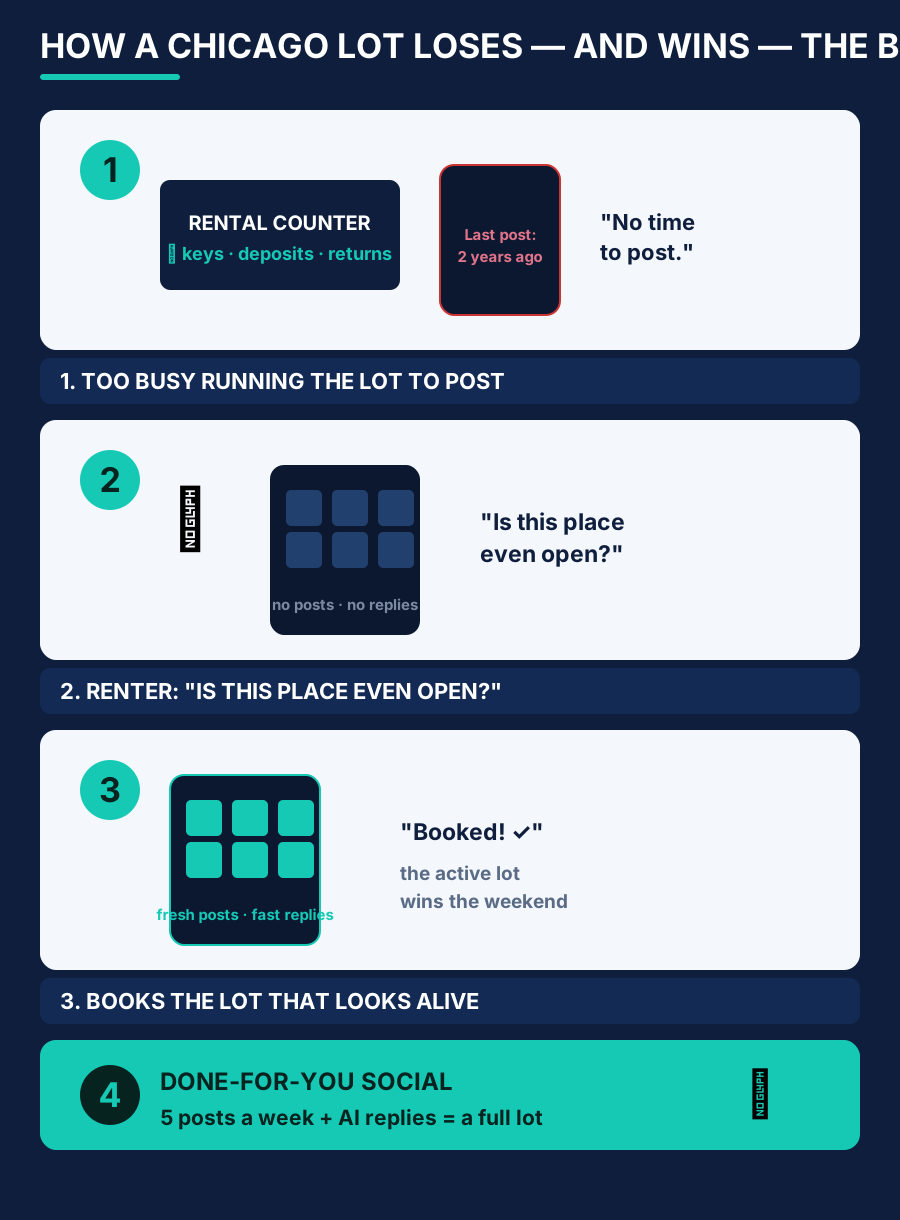
The uncomfortable truth: your fleet, your rates, and your service can all be better than the lot down the road, and you’ll still lose the booking if their window looks open and yours looks dark. Presence isn’t vanity — it’s the price of being considered.
Pain #3: Comments and DMs go cold — and cold means lost
Posting gets you seen. What actually converts the view into a booked car is the reply — and this is where most rental lots quietly hemorrhage. A “do I need a deposit for the SUV this weekend?” comment or a Friday-night “is anything available for Saturday?” DM is a renter with their card practically out. Leave it overnight and it’s gone.
The expectations are unforgiving. About 73% of consumers expect a brand to respond within 24 hours or sooner — and the same share will simply buy from a competitor when a brand fails to respond to their message (Sprout Social). For a weekend rental decision, 24 hours is generous — the renter needing a car tonight has already booked elsewhere by morning. Speed-to-reply is the whole game, which is why the same urgency that drives missed-call text-back for rentals applies to every comment and DM too.
The trouble is that a human at the counter can’t watch Instagram, Facebook, and TikTok comment threads at 9 p.m. on a Friday — which is precisely when the weekend booking rush hits. That’s the gap AI closes: an Instagram DM automation that answers instantly, in your brand voice, qualifies the renter, collects their dates and vehicle class, and drops the appointment straight onto your calendar — 24/7, whether you’re at the lot or asleep.
Pain #4: You’re invisible where discovery now happens
Here’s the shift a lot of rental owners missed: social stopped being just a place to reassure people who already found you. It’s now the main way new renters find you at all — and that discovery runs almost entirely on short video.
The reach gap is stark. Instagram Reels reach roughly 2.25× more accounts than single-image posts, according to Buffer’s analysis of hundreds of thousands of posts (Buffer) — and a large share of those Reel views come from people who don’t already follow you, which is exactly the new-renter audience you can’t reach any other way. Marketers agree on where the ROI is: short-form video delivers the highest return of any content format (HubSpot).
For a rental lot, this is a gift — if you use it. A 20-second walkaround of a clean SUV, a “3 steps to grab your airport pickup” clip, a fast fleet reveal — that’s the content most likely to reach a Chicago traveler who has never heard your name. It’s also the content least likely to get made when one person is running the whole operation, because video feels like the highest-effort format. The lots that show up in short video every week get a fresh shot at a breakout post; the lots that don’t stay a well-kept secret. (The mechanics of each channel are their own playbooks — see our guides on Instagram and TikTok for rental businesses.)
What done-for-you social actually looks like
Here’s the operator’s honest conclusion from all four pain points: the work is real, it’s daily, and it doesn’t fit inside a day already spent running a lot. That’s the entire case for handing it to a team built for exactly this niche — so your feed stays alive, your DMs get answered, and you never touch a content calendar.
Done right, a hands-off rental social operation looks like this:
- A steady weekly content engine — a Q&A text post, a branded image, two swipeable carousels, and a short reel every week, written in your lot’s voice, published across the channels renters actually use.
- Every channel covered, correctly. One brand voice, cropped and captioned for each platform — Facebook, Instagram, Google Business Profile, LinkedIn, TikTok, YouTube, and more — instead of one tired app you update when you remember.
- AI that answers and books. Comment, DM, and website-chat agents that reply in seconds, qualify the renter, and put the appointment on your calendar 24/7 — so the 9 p.m. Friday “is the SUV free?” never goes cold.
- Leads in one place. Every name, phone number, rental date, and conversation lands in a CRM you can log into — not scattered across five app inboxes.
That’s precisely what our done-for-you social media service for car rental operators delivers — a full weekly content set across nine channels plus three AI agents for comments, DMs, and web chat, white-label, from a flat monthly rate. It replaces a designer, a video editor, a social manager, and a community manager with one system built for rental lots.
A realistic 90-day picture
No honest partner promises overnight virality, and you should distrust anyone who does. Organic social compounds — here’s the truthful arc for a rental lot that goes from dark to consistently active.
- Weeks 1–4: The feed comes back to life across every channel, and the AI agents start catching comments and DMs the same day. Your existing followers — past renters, locals — start engaging again, and the “is this place still open?” signal flips to “clearly operating.”
- Months 2–3: Consistent posting plus short video begins reaching renters who’ve never heard of you. This is the window where a single reel can genuinely break out and flood you with weekend inquiries, because you finally have enough shots on goal for one to land.
- Months 3+: Compounding trust. Steady content and instant replies make you the obvious, safe choice in your market, and inbound reservations from social become measurable and repeatable — the same flywheel that makes your local SEO and paid ads work harder.
The point isn’t to turn you into a content creator. It’s to make sure that when a Chicago renter runs their fifteen-second trust check — and O’Hare’s 80 million passengers guarantee thousands do it every week — your lot is the one that looks open, answers fast, and gets the booking.
Frequently asked questions
Does social media really affect car rental bookings, or is it just vanity metrics?
It directly affects bookings. About 74% of consumers check a brand's social profiles before visiting in person, and 67% now buy through social at least once a month, so your feed is part of the actual purchase decision — not decoration. For a Chicago rental lot competing for O'Hare and tourist traffic, an active, answered social presence is often the tiebreaker between two lots at similar prices.
How often should a Chicago car rental company post on social media?
Consistency matters more than volume — social marketers put the baseline to stay visible at roughly 3 to 5 posts a week on each major platform, ideally a mix of a Q&A post, a branded image, carousels, and at least one short reel. That cadence per channel is hard to sustain by hand while running a lot, which is exactly why many rental operators move it to a done-for-you team.
Why does short video matter so much for rental lots?
Short video is where new renters discover you. Instagram Reels reach roughly 2.25 times more accounts than single-image posts, and much of that reach comes from non-followers — the travelers and locals who don't know your lot yet. Marketers also report short-form video as the highest-ROI format. A 20-second fleet walkaround or airport-pickup clip is the single best tool for reaching renters you've never met.
What happens if I just leave my comments and DMs unanswered?
You hand the booking to a competitor. Around 73% of consumers expect a response within 24 hours or sooner, and the same share say they'll buy from a competitor when a brand fails to respond — and for a weekend rental, even a few hours is too slow. AI comment, DM, and web-chat agents close that gap by replying instantly, qualifying the renter, and booking the appointment 24/7.
Do I have to hand over my account passwords for a done-for-you service?
No. A properly run service never needs your passwords — you connect your existing accounts to a social planner platform yourself and stay in full control, able to disconnect anytime. Every lead and appointment the AI agents capture lands in a CRM under your own login, so you always see the names, phone numbers, and rental dates coming in.
About the author: Priya Sandoval is a GoHighLevel Agency Owner & Snapshot Builder based in Austin, Texas. She runs a boutique agency that builds and resells done-for-you automation and social systems for local service businesses, with car-rental operators as her fastest-growing segment. She writes about the unglamorous plumbing — content cadence, DM automation, and pipeline timing — that turns a one-time renter into a repeat booking.
Related reading:
- Instagram Marketing for Car Rental Businesses: The 2026 Playbook
- TikTok Marketing for Car Rental Businesses
- Missed-Call Text-Back for Car Rentals: Stop Losing Weekend Bookings
- Local SEO for Car Rental Businesses: The 2026 Google Ranking Playbook
- Car Rental Website Conversion: Turn More Visitors Into Booked Rentals
Editorial note: figures cited are drawn from the third-party research linked inline and reflect those sources as of publication. Social platform reach, consumer-behavior, and market figures are cohort or survey findings, not a prediction for any specific lot; results depend on execution, fleet, market, and offer. GHL Car Rental Snapshot builds GoHighLevel automation systems, websites, and done-for-you social operations for car rental businesses — it is not a car rental company, insurer, or payment processor. Market data and platform behavior change; confirm current sources before making decisions.