
It is 9:10am on a Saturday and two people are standing at your counter for the same car. One booked the silver Tahoe on Turo three weeks ago. The other booked it on your own website on Thursday night. Both have confirmations. You have one Tahoe, and whoever you turn away is going to feel lied to, leave a one-star review, and maybe call their bank. You did not oversell on purpose. Turo and your website just never talked to each other.
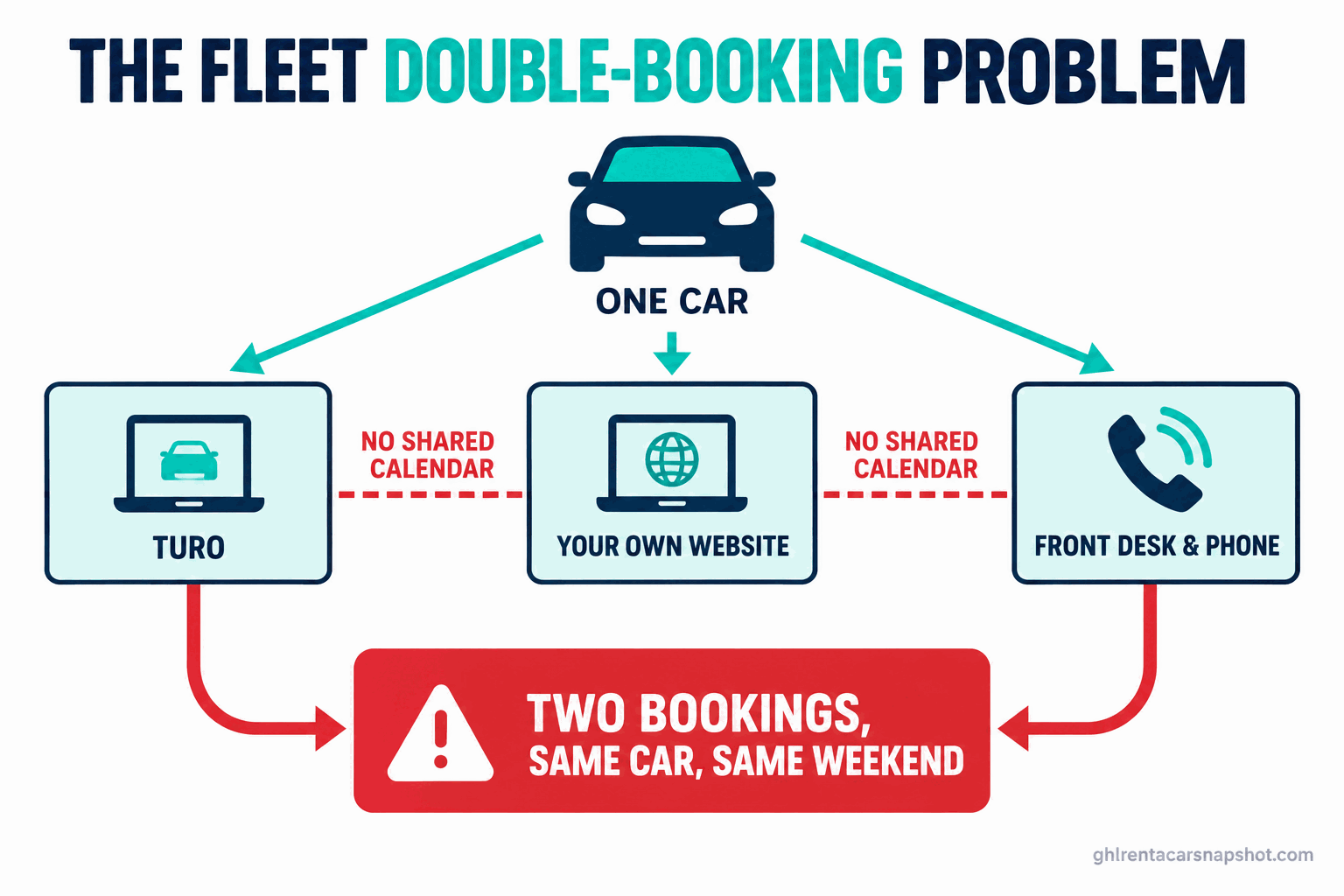
Here is the short version so you can fix it today. A fleet double-books when the same car is bookable in two places that do not share one calendar. Turo shut down its third-party API in 2023 and gives you no supported way to auto-sync availability (TechCrunch), so you cannot just plug it into your website and walk away. The fix is a system: pick one source of truth for availability, decide which cars live on which channel, build buffer time into every turnaround, lock the gaps the platforms leave open, and reconcile the fleet once a day.
Key Takeaways
- Double-booking is a sync problem, not bad luck. One car bookable in two places with no shared calendar.
- Turo gives you no API and no supported calendar sync. It closed third-party API access in 2023 (TechCrunch), so cross-platform sync is a discipline you build, not a toggle you flip.
- A walked renter is expensive twice. You lose the trip and often eat a chargeback, about $128 on average on top of the refund (Mastercard).
- Own a channel the platform cannot switch off. Getaround closed its entire US business in February 2025 (TechCrunch). Your own site is the only calendar nobody else controls.
Table of contents
- What a double-booking actually costs you
- Why your fleet gets double-booked
- The fleet-sync system, start to finish
- Stage 1: One source of truth
- Stage 2: Which cars live on which channel
- Stage 3: Build buffer time into every turnaround
- Stage 4: Lock the gaps the platforms leave open
- Stage 5: Confirm bookings and alert on conflicts
- Stage 6: Reconcile the fleet once a day
- Three scenarios: 3, 20, and 80 cars
- Texting a renter you had to move
- Steal these: the double-booking scripts
- Common objections, answered
- Frequently asked questions
What a double-booking actually costs you
A double-booking costs you the booking you already won, plus the goodwill, plus often the money itself.
First, the trip is gone: you refund it or comp an upgrade you did not want to give. If the renter paid by card and feels wronged, the next step is a chargeback. Mastercard puts the average all-in cost of one at roughly $128 for a merchant, on top of refunding the sale (Mastercard). And you usually lose: “I showed up and there was no car” is a dispute the renter wins.
The average all-in cost of one chargeback to a US merchant, in dollars, on top of the refunded sale. Source: Mastercard, “The true cost of a chargeback,” 2025.
Second, the review. There is no clean car-rental number here, but hospitality has studied its version: Cornell found around 70% of guests who get “walked,” moved because a room was oversold, do not come back (eCornell). A stranded renter behaves the same way. One public “they double-booked me and left me stranded” review sits on your profile for years and kills bookings you never see.
Why your fleet gets double-booked
You are not careless. You are running one fleet through channels that were never built to agree: Turo, your own website, walk-ins and phone, a corporate account. That is four or five doors into the same car, and unless something keeps them in step, two of them open onto the same weekend.
Turo makes this harder on purpose. It cut off third-party API access in April 2023, killing the fleet tools hosts used to sync cars across platforms, and has kept the system closed since (TechCrunch). There is no supported way to pipe your Turo availability into your website, so the “just connect them” answer that works for a hotel channel manager is not available to you. That constraint is why this is a system, not a setting.
The fleet-sync system, start to finish
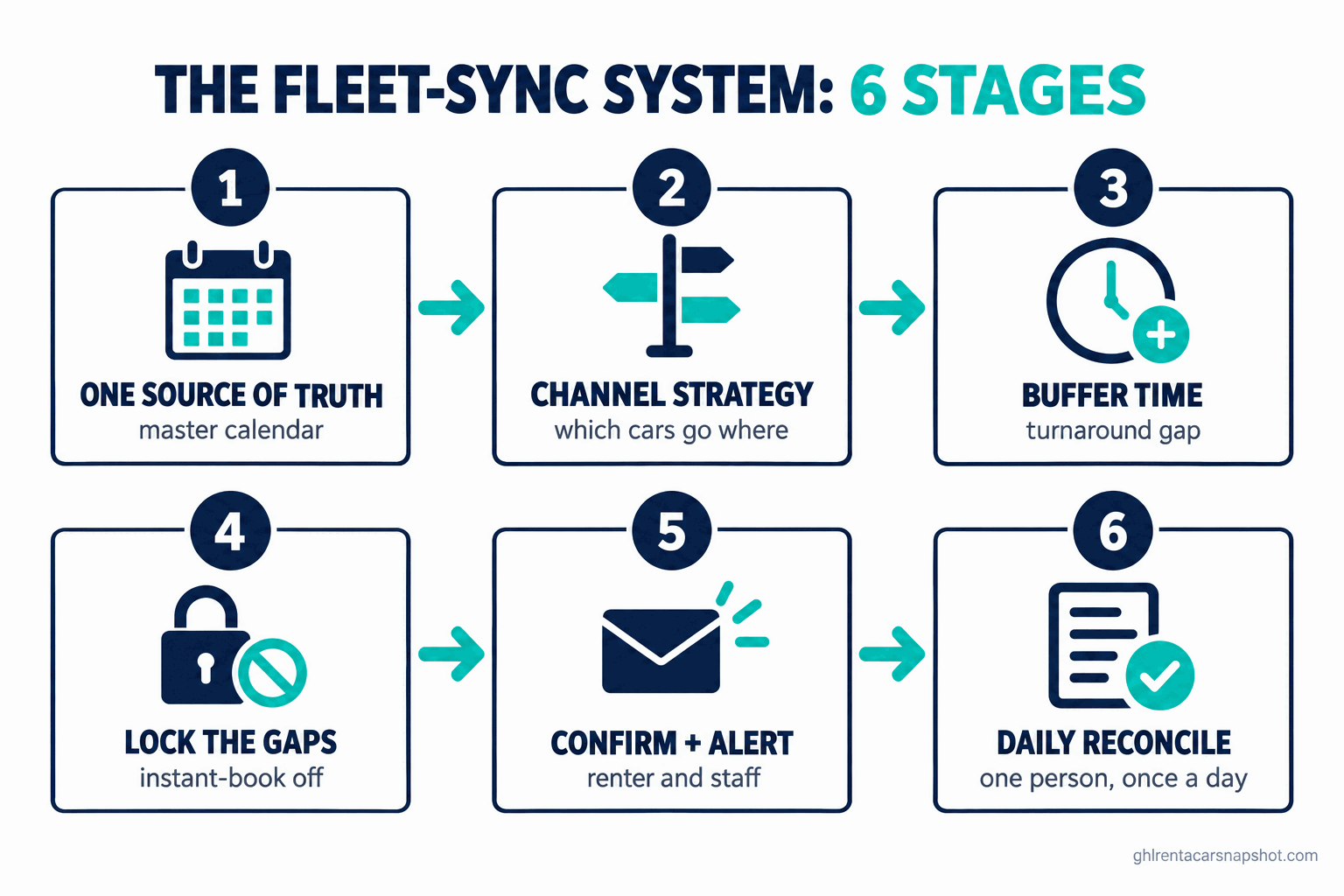
Six stages, each closing a door that double-bookings walk through: one source of truth, a deliberate channel strategy, buffer time on every turnaround, locks on the gaps platforms leave open, confirm-and-alert on every booking, and a daily reconcile. Take them one at a time.
Stage 1: One source of truth
Decide what everything syncs to. You need one calendar that is the final word on whether a car is free, and every other channel bends to it. For most independents that master is your own booking system, the one place you fully control and the one holding the renter’s real contact details.
The master does three jobs: it shows every car and reservation in one view, it is what your counter checks before saying yes to a walk-in, and it is where you manually block the dates a car is committed somewhere you cannot sync. A spreadsheet can be the master if you are tiny and disciplined, but it breaks the second two people edit it at once. If you are still on paper and WhatsApp, the digital rental agreement and booking flow is the same build.
Stage 2: Which cars live on which channel
The cleanest way to cut double-bookings is to stop the same car from being bookable in two uncontrolled places. Put your high-demand, hard-to-replace cars on your own site only, where you control the calendar and keep the whole fee. Use Turo for the cars where its reach fills days you would otherwise lose, and accept those need manual blocking.
The commission math makes this choice for a lot of operators. Turo keeps between 10% and 30% of each trip under its 2026 earnings plans, depending on the protection tier, and last-minute bookings can pay the host as little as 65% (Lane, Rentovation). On a $1,000 week that is $100 to $300 you hand over, every trip. A booking on your own site keeps all of it.
The channels differ on more than price. Here is how they stack up on what causes double-bookings and costs you money:
| Turo | Your own website | Front desk & phone | |
|---|---|---|---|
| Who owns the renter | Turo | You | You |
| Commission per trip | 10-30% | 0% | 0% |
| Can it auto-sync a calendar | No (API closed 2023) | Yes, it is your master | Only if staff check it |
| If the platform disappears | You lose the channel | You still have it | You still have it |
That last row is not hypothetical. Getaround wound down its entire US business in February 2025 (TechCrunch), and hosts who built their whole book on it woke up with no marketplace. Your own channel is the one calendar nobody can switch off, the deeper point under the Turo-versus-your-own booking math.
Stage 3: Build buffer time into every turnaround
A surprising share of double-bookings are overlap bookings. The car is due back at 11 and promised out at 11, the renter brings it in at 11:40 with a quarter tank and a coffee stain, and the next renter stands there while you clean a car that should already be ready.
Stop treating the return time as the next pickup time. Build a turnaround buffer into the calendar so no car is bookable back-to-back. A couple of hours covers a standard turnaround (inspect, clean, fuel, photograph); an exotic needs half a day. The buffer is also the window where you document the car out and back, the same timestamped-photo habit that wins deposit and damage disputes. Set it once so every reservation reserves the window after it. On Turo, where you cannot enforce it, it becomes a manual rule: a trip ends at 11, you block your own channels until 1.
Stage 4: Lock the gaps the platforms leave open
Two gaps cause most of the remaining collisions, both from a channel booking a car faster than your master can hear about it.
First is instant booking. If Turo’s instant-book is on, a trip can confirm while that car is mid-checkout on your website, and neither side knows. If you cannot sync the two, turn instant-book off on cars that are also live on your own site, so a Turo request is accepted by a human who can glance at the master first.
Second is the after-hours and walk-in gap. The phone rings at 7pm and your counter person books a car onto a sticky note without opening the master. By morning the website has sold it. Every manual booking, walk-in, phone, or corporate hold, has to land in the master the moment it is made, not “later,” the same missed-call text-back and after-hours capture discipline: answer fast, commit only against the real calendar.
Stage 5: Confirm bookings and alert on conflicts
Once a booking lands, two messages fire. One goes to the renter with the car, date, time, and location, which heads off the “I thought it was Sunday” confusion that looks like a double-booking but is really a mix-up. The other goes to you, an internal alert, the moment a new booking touches a car that already has a reservation or buffer in that window.
The conflict alert is cheap insurance. You cannot force Turo to sync, but you can make your own system flag any overlap you control, and make it a rule that a staffer logs every Turo trip into the master the same day. The alert turns a Saturday disaster into a Thursday phone call, when you still have time to fix it. It is the same workflow automation that runs no-show and cancellation recovery.
Stage 6: Reconcile the fleet once a day
Automation handles the channels you control. A human handles the one you do not. Once a day, one person opens the master calendar and the Turo trip list side by side and makes them agree, looking for three things: a Turo trip confirmed but not yet blocked on your own channels, a tight turnaround where a late return will clip the next pickup, and any conflict alert still unresolved. Make it a named job. “Someone checks the calendar” means nobody does; “Priya reconciles the fleet at 6pm and 7am” means it happens.
Three scenarios: 3, 20, and 80 cars
The system is the same shape at every size. What changes is how much is manual.
The side-hustle host, 3 to 5 cars. Run it on one shared calendar and discipline. Pick your master, turn Turo instant-book off, and block a trip on your other channels the minute it confirms. Your whole risk is texting a repeat renter and forgetting to log it, so a two-minute nightly glance covers you. Keep your utilization in view so you know which cars earn their Turo listing.
The growing lot, 15 to 30 cars with staff. Now more than one person can book a car, which is where sloppiness lives. You need a real reservation system as the master, automatic buffers, conflict alerts on, and one hard rule: no car gets promised to anyone, walk-in or phone or Turo, without going into the master first.
The multi-location operator, 50 to 80-plus cars. Several locations, corporate holds, and heavy Turo volume mean manual blocking alone will not keep up. Lean on automation for everything you control and staff the Turo reconcile as a daily task. Whether to build on GoHighLevel or a dedicated rental system is its own software decision.
Texting a renter you had to move
Sometimes the system catches a clash too late to prevent, and you have to tell a renter their car changed. That message is a text, and the moment you text renters, three rulebooks apply.
You must be a registered sender: since February 2025, US carriers block texts from unregistered A2P 10DLC numbers outright, so your apology never arrives (JustCall). From June 30, 2026, campaign registration also requires a public Privacy Policy URL and Terms and Conditions URL, or it is rejected (Twilio). Ignore any old advice built on the FCC “one-to-one consent” rule; it was vacated in January 2025 and repealed (Womble Bond Dickinson). And if you rent in or to Florida, the Florida Telephone Solicitation Act lets a renter sue you directly for $500 to $1,500 per text (Pillsbury). The good news: a message about a booking the renter made is transactional and low-risk, as long as you do not bolt a promotion onto it. Full rules are in the TCPA and 10DLC guide.
Steal these: the double-booking scripts
Swap in your details; each stays about the booking.
Internal conflict alert (to you or your counter, the moment channels clash):
CONFLICT: {car} is booked twice for {date}. Website res #{id} ({renter A}) and Turo trip ({renter B}). One must move. Check the master calendar and resolve before {cutoff}.
The apology-and-rebook, same car class (send the second you catch it, inside quiet hours):
Hi {first name}, it’s {business}. I’m sorry, we hit a scheduling conflict on your {car} for {dates}. I have the same class ready for you, a {alt car}, at the same price, and I’ll add a full tank for the trouble. Reply YES and I’ll lock it in, or call me at {phone}.
The can’t-cover message (when you genuinely cannot honor it):
Hi {first name}, this is {business}. I owe you an honest heads-up: we double-committed your {car} for {dates} and I can’t get you an equivalent in time. I’ve refunded you in full today and I’d like to give you {credit} toward a future rental. I’m sorry, this one is on us.
None of these bolt a promotion onto an operational message, which keeps them transactional and low-risk.
Common objections, answered
“I only rent on Turo, so this isn’t my problem.” Then you have one channel and no double-booking risk today. But you also hand Turo 10% to 30% of every trip and build your business on a platform that can change the rules or, like Getaround, close the market overnight (TechCrunch). Add your own booking site and this becomes your problem, so build the habit before you need it.
“Can’t I just sync Turo to my website like a hotel channel manager?” No, and this is the trap. Turo closed its third-party API in 2023 and offers no supported calendar sync (TechCrunch). Any tool claiming to auto-sync your Turo calendar is an unofficial workaround. Build the manual reconcile instead.
“Won’t blocking dates and turning off instant-book cost me bookings?” A little, and it saves far more. An instant-book trip you have to cancel is worse than a request you declined, because it hits your platform standing and burns a customer. The trade is a few marginal last-minute trips for zero double-booking disasters.
Frequently asked questions
Can I automatically sync my Turo calendar with my own booking website?
No. Turo shut down third-party API access in April 2023 and offers no supported iCal or API sync for host availability, so there is no reliable way to auto-sync Turo with your website. Any product claiming to do it is an unofficial workaround that can break when Turo changes its site. The dependable approach is manual: make your own booking system the master and block a car on your other channels the moment a Turo trip confirms.
What is the fastest way to stop double-booking with a small fleet?
Three moves cover most of it. Turn Turo instant-book off on any car also bookable on your own site, so a human accepts each request after checking the master calendar. Build a turnaround buffer so no car is bookable back-to-back. And reconcile the fleet once a day. For three to five cars that takes two minutes.
How much does a double-booking actually cost?
More than the trip. You refund or comp the walked renter, you often eat a chargeback that costs a merchant about $128 on average on top of the refund, and you risk a public one-star review that deters bookings for years. Hotel research found roughly 70% of walked guests never return, and a stranded renter behaves the same way.
Should I list the same car on Turo and my own site?
Only deliberately. Keep your highest-demand, hardest-to-replace cars on your own site, where you keep the full fee, and use Turo for cars where its reach fills days you would otherwise lose. Cross-listing every car by default is what creates double-booking exposure.
What happens to my fleet if a marketplace shuts down?
If your bookings live only on a platform, you lose the channel and the customer relationships with it. Getaround wound down its entire US business in February 2025 and its hosts lost the marketplace overnight. Your own booking website is the one calendar and customer list nobody else controls.
It is 9:10am again next Saturday. The silver Tahoe is being detailed in the bay, blocked on every channel until 1pm because a Turo trip returns at 11 and your buffer rule handled it on Thursday. The one person at your counter is the renter who is supposed to be there, keys cut, agreement signed. That is what a synced fleet buys you: a quiet counter and a car exactly where you said it would be.